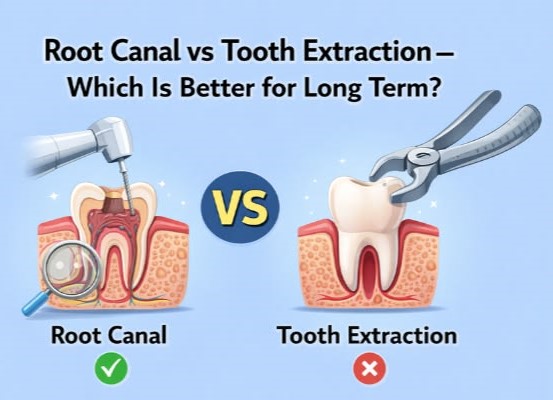
When a tooth becomes painful, infected, or badly damaged, patients often hear two possible treatment options from the dentist: root canal treatment or tooth extraction. That’s when the confusion starts—because both sound like big procedures.
Some people feel root canal is complicated and extraction is easier. Others want to save the tooth no matter what. But the smarter decision is not based on fear—it’s based on what is best for your mouth in the long run.
So let’s answer the real question clearly: Root canal vs extraction—what is actually better?
What Exactly is a Root Canal?
A root canal treatment (RCT) is done when the nerve inside the tooth gets infected or inflamed. This usually happens due to:
- deep tooth decay
- a cracked or fractured tooth
- old, leaking fillings
- injury or trauma to the tooth
In a root canal, the dentist removes the infected nerve tissue, cleans the inside of the tooth properly, disinfects it, and seals it. After that, the tooth is usually covered with a dental crown to restore its strength.
The goal of root canal is simple:
Remove infection and save the natural tooth.
What Happens in Tooth Extraction?
A tooth extraction is the complete removal of a tooth from the jaw. Dentists recommend extraction only when the tooth cannot be saved, such as:
- tooth broken below gum level
- severe decay leaving very little tooth structure
- deep cracks reaching the root
- infection affecting the supporting bone heavily
- repeated failure of prior treatments
Extraction removes the problem tooth, but it also creates a gap. If that missing tooth is not replaced, it can cause many future issues.
Root Canal vs Extraction: Which One Is Better?
Here’s the honest answer:
Root canal is better when the tooth is restorable.
Extraction is better when the tooth is beyond repair.
Now let’s compare them properly.
1) Which One is Less Painful?
Many patients fear root canal, but this fear is outdated.
Modern root canal treatment is done under anesthesia, and most patients feel little to no pain during the procedure. In fact, root canal is usually performed to relieve severe pain caused by infection.
Extraction is also done under anesthesia, but healing after extraction may cause soreness for a few days. If the tooth was infected, swelling and discomfort can be slightly more common.
So overall:
Both can be comfortable, but root canal often feels easier because the tooth is treated instead of removed.
2) What is Better for Long-Term Oral Health?
This is the biggest point.
Saving a natural tooth is generally better than removing it, because your natural tooth:
- keeps your bite balanced
- protects jawbone strength
- prevents nearby teeth from shifting
- supports proper chewing and speech
When a tooth is extracted and not replaced, the nearby teeth slowly start moving towards the empty space. The opposite tooth (upper or lower) can also grow into the gap. Over time, the jawbone in that area starts shrinking, which can affect facial structure and bite.
Root canal helps maintain normal function and structure.
3) Which Option is More Affordable?
Many people choose extraction because it looks cheaper initially.
- Extraction: cheaper at first
- Root canal: slightly costlier at first
But the real cost comes later.
After extraction, if you want proper function again, you may need:
- implant (most ideal but higher cost)
- bridge (requires support teeth)
- denture (less comfortable for single missing tooth)
That means extraction is often not the final cost—it is only the start.
Root canal usually becomes the better value because you save the tooth and avoid expensive replacements.
4) Which Option Lasts Longer?
A properly done root canal with a crown can last many years—sometimes decades—if oral hygiene is maintained and regular dental check-ups are done.
However, a root canal tooth becomes weaker because the nerve is removed, which is why a crown is recommended, especially for back teeth.
Extraction removes the tooth permanently. Even with a replacement like an implant, it will never feel exactly like a natural tooth.
If the tooth can be saved, saving it usually gives the most natural long-term result.
5) When Extraction is Actually the Better Choice
Root canal is not a magic solution. Some teeth simply cannot be saved, and trying to save them becomes a waste of money.
Extraction is usually better when:
- tooth has a deep vertical crack
- most of the tooth structure is missing
- infection has severely damaged the bone
- the tooth cannot support a crown
- multiple failed treatments have reduced the success rate
In such cases, extraction followed by replacement (preferably implant) is a more sensible plan.
A good dentist will always tell you honestly whether the tooth is savable or not.
Quick Decision Guide
Root Canal is better if:
- tooth can be rebuilt with crown
- infection is limited to inside the tooth
- tooth has strong support in bone
- you want to keep natural bite
Extraction is better if:
- tooth is too broken or cracked
- decay has destroyed the tooth deeply
- bone support is severely damaged
- saving the tooth has a low success rate
Conclusion
If your tooth can be saved, root canal treatment is usually the better choice, because your natural tooth is always the best option for chewing, comfort, and stability. Extraction should only be done when the tooth is not restorable. And if extraction is required, replacing the missing tooth at the right time is important to prevent future dental issues.
Doctor Name: Dr. Aashish Dilip
Clinic Name: Pune Best Dentist
Website: https://punebestdentist.com/